Vegan · Meze · Mediterranean
Greek Vegan Dolmades
Stuffed grape leaves with herbed rice, pine nuts, and lemon — the definitive guide
Dolmades are one of the few dishes in the Greek repertoire that require no adaptation to be vegan. The traditional rice-and-herb filling wrapped in vine leaves and simmered in lemony broth has been plant-based for centuries — long before the word "vegan" existed. The dish predates the concept entirely. Greek dolmadakia (the diminutive form, meaning "little dolmades") were born from a practical reality: rice was cheap, herbs grew wild, and grape leaves were abundant. Meat was reserved for feast days. What resulted was a naturally vegan meze that became one of the most recognizable dishes across the entire Mediterranean — from Athens to Beirut to Istanbul to Aleppo. This guide covers everything you need to make authentic vegan dolmades at home: the choice between fresh and jarred leaves, the filling that balances texture and flavor, rolling techniques that hold during cooking, and two methods for achieving the silky, lemon-infused result that defines the dish.
A Dish That Belongs to Everyone — and to Greece in Particular
Dolmades provoke debate wherever they appear. Turks claim them as sarma. Lebanese call them waraq enab. Armenians, Syrians, Persians, and North Africans all have versions. The word itself — dolma — is Turkish for "stuffed." This is not a controversy to resolve; it is a history to understand.
The Ottoman Empire controlled much of the eastern Mediterranean for four centuries. During that period, culinary traditions crossed borders continuously — not through conquest but through kitchens. Greek cooks adopted techniques from Turkish neighbors, Turkish cooks borrowed from Greek ones, and both drew from the broader Byzantine tradition that preceded them. The grape vine, cultivated in Greece since at least the 3rd millennium BCE, provided the wrapper. Rice, introduced through trade routes, filled the leaf. The result became shared inheritance.
What distinguishes Greek dolmades from regional cousins is a specific flavor profile: lemon, dill, and mint. Lebanese versions often include allspice and tomato. Turkish sarma may use pine nuts, currants, and cinnamon. Armenian preparations sometimes add sour cherries. The Greek approach is deliberately restrained — the vine leaf, the herbs, the lemon, and the olive oil are allowed to speak without interference. This restraint is the foundation of the vegan version, and it is what makes it exceptional.
Fresh vs Jarred Grape Leaves: The Decision That Changes Everything
The single most important ingredient decision in making dolmades is not the filling — it is the leaf. Fresh and jarred grape leaves produce meaningfully different results, and understanding why helps you choose.
| Factor | Fresh Leaves | Jarred / Brined |
|---|---|---|
| Availability | Spring through early summer only | Year-round |
| Flavor | Subtly sweet, grape-like, more delicate | Tangier from brine, slightly more assertive |
| Texture after cooking | Softer, more tender, almost silky | Slightly firmer, more structural integrity |
| Preparation | Blanch 2 minutes, shock in cold water, trim stems | Rinse, soak 10 minutes to reduce salt, trim stems |
| Size consistency | Variable — pick through for usable leaves | More uniform, but small/torn leaves included |
| Best for | Special occasions, when flavor purity matters | Weeknight cooking, meal prep, year-round dolmades |
How to Prepare Each Type
Fresh leaves: Bring a large pot of water to a boil. Drop leaves in batches for 2 minutes — no more, or they become too fragile to roll. Transfer immediately to an ice bath. Drain, pat dry, and trim the tough stem from each leaf. You'll lose about 20-30% of fresh leaves to tearing or undersize — always harvest or buy double what you think you need.
Jarred leaves: Remove from the jar and rinse thoroughly under cold running water for 2-3 minutes. This removes excess brine salt. Soak in a bowl of cold water for 10 minutes, then drain. Sort through the leaves: large, intact ones are for rolling. Small or torn leaves line the pot bottom. A standard 16-ounce jar yields approximately 40-50 usable leaves.
The Filling: Where Texture Meets Fragrance
The filling for vegan dolmades is not merely rice stuffed into a leaf. It is a carefully calibrated mixture where each ingredient serves a specific purpose. Understanding this transforms dolmades from adequate to exceptional.
Filling ingredients (makes 30-36 dolmades)
- 1.5 cups short-grain or medium-grain rice (Arborio works)
- 1/2 cup pine nuts, lightly toasted
- 1 large onion, finely diced
- 4 scallions, thinly sliced
- 1/3 cup fresh dill, chopped
- 1/3 cup fresh mint, chopped
- 1/4 cup fresh parsley, chopped
- Zest of 2 lemons
- 1/3 cup fresh lemon juice
- 1/2 cup olive oil, divided
- 1 teaspoon ground allspice
- 1/2 teaspoon ground cinnamon
- 1/2 teaspoon ground nutmeg
- 1 teaspoon salt
- 1/2 teaspoon black pepper
The Rice Question: Why Grain Type Matters
Short-grain or medium-grain rice is correct. These varieties produce the slightly sticky, cohesive texture that holds the filling together inside the leaf. Basmati or long-grain rice — while tempting for its fragrance — produces individual, separated grains that create a loose filling prone to falling apart when you bite into the dolma. If you cannot find short-grain, Arborio (risotto rice) is an excellent substitute.
The rice must be parboiled before filling. This is non-negotiable. Raw rice inside a grape leaf may not cook evenly — the outer grains absorb too much liquid while the center stays hard. Fully cooked rice becomes mushy and expands too much during the second cooking. Parboil: combine rice with water (1 cup rice to 1.5 cups water), bring to a simmer, cover, and cook 5-7 minutes until the water absorbs but the rice remains slightly firm in the center. Cool before folding in herbs.
Why Pine Nuts Change Everything
Pine nuts are not traditional in every Greek dolmades recipe, but their inclusion elevates the dish significantly. Lightly toast them in a dry pan for 2-3 minutes until golden — this intensifies their buttery flavor. Fold them into the cooled rice filling. They provide textural contrast (crunchy against soft rice), fat richness (compensating for the absence of meat), and visual appeal (golden flecks against green herbs). If pine nuts are unavailable or cost-prohibitive, sunflower seeds or chopped walnuts are acceptable substitutes, though neither matches the specific flavor profile.
The Herb Ratio
The combination of dill, mint, and parsley in roughly equal proportions creates the signature Greek dolmades flavor. Dill provides the primary aromatic note — its anise-like brightness is unmistakable. Mint adds coolness and sweetness. Parsley grounds everything with earthy freshness. All three must be fresh. Dried herbs cannot replicate the brightness and color that fresh herbs bring to this dish. The herbs are folded into the rice after cooking and cooling — heat destroys their volatile oils and dulls their color.
Variation: pine nut-free budget version
Replace pine nuts with 3 tablespoons of toasted sunflower seeds and add 2 tablespoons of golden raisins for sweetness. This produces a different but still delicious dolma — closer to the Lebanese waraq enab tradition while remaining fully vegan.
Rolling Techniques: Three Methods, One Goal
Rolling dolmades is the step that intimidates most home cooks. It shouldn't. The technique is simple once you understand the principle: tight enough to hold together, loose enough to allow rice expansion.
Method 1: The Standard Roll (Most Common)
Place one leaf veiny side up on a flat surface, stem end pointing toward you. Add 1 heaped tablespoon of filling near the stem end — a thin log shape, about 2 inches wide. Fold the stem end up and over the filling. Fold the left side in toward the center, then the right side. Roll forward toward the leaf tip, keeping it snug. The result should be a compact cylinder about 2-3 inches long. This is the method used by most Greek home cooks and produces the classic dolmadakia shape.
Method 2: The Cigar Roll (For Larger Leaves)
When working with large, intact leaves (especially fresh ones), the standard roll can produce dolmades that are too thick. Instead, cut the leaf in half along the central vein. Use each half to make a smaller, thinner roll. This produces an elegant, cigar-shaped dolma that fits more neatly on a meze platter and cooks more evenly.
Method 3: The Open-End Roll (For Presentation)
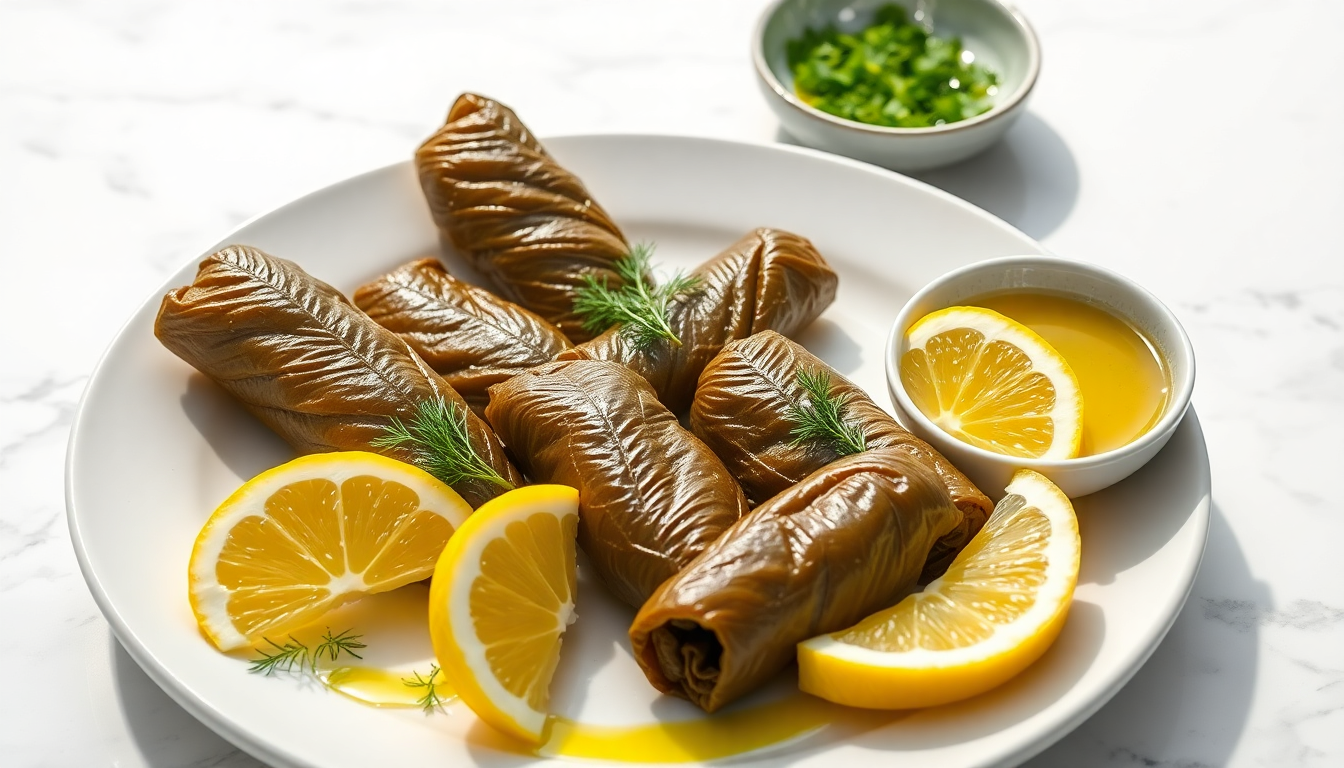
Roll the dolma as normal but leave the top and bottom ends slightly open, allowing the rice filling to be visible. This produces a less traditional but visually striking result — especially effective when serving on a platter with lemon wedges and dipping sauce. The trade-off: open-ended dolmades are more fragile and require more careful handling during cooking.
The plate trick
Whatever rolling method you choose, place an inverted plate on top of the arranged dolmades before adding liquid. This prevents them from floating and unraveling during cooking. The plate should be slightly smaller than the pot diameter so liquid can flow around its edges.
Two Cooking Methods
The simmering method is traditional and most common. The baking method is less authentic but produces a slightly more concentrated flavor. Both work.
Method 1: Stovetop Simmer (Traditional)
Line the pot bottom with reserved torn leaves. Arrange dolmades seam-side down in tight concentric circles, packing them closely enough that they support each other. Pour broth or water to just cover the dolmades. Add remaining lemon juice and olive oil. Place the inverted plate on top. Cover with a lid.
Bring to a gentle simmer over medium heat — not a boil. A hard boil causes the rice to expand too quickly and can burst the leaves. Reduce to the lowest heat that maintains a gentle simmer. Cook 45-55 minutes. Check at the 30-minute mark: the liquid should be mostly absorbed, and the leaves should be tender when tested with a fork. If liquid remains, remove the lid for the last 10 minutes to allow evaporation.
Remove from heat and let stand, covered, for 15 minutes. This resting period allows the remaining liquid to absorb and the rice to finish cooking in residual steam.
Method 2: Oven Bake (More Concentrated)
Arrange dolmades in a baking dish as above. Preheat oven to 325°F (160°C). Pour liquid and lemon juice over the dolmades, cover tightly with foil, and bake for 1 hour. The gentler, more even heat of the oven produces a slightly more concentrated flavor and a more uniform texture. This method is useful when your stovetop is occupied or you prefer hands-off cooking.
Dipping Sauces: Three Vegan Options
Dolmades are traditionally served with a dipping sauce. Here are three vegan versions that complement the lemony, herbal character of the dish.
Cashew-Lemon Cream
Soak 1 cup raw cashews in boiling water for 30 minutes. Drain. Blend with 2 tablespoons lemon juice, 1 small garlic clove, 2-3 tablespoons water (add gradually for desired consistency), salt, and pepper. The result is a silky, tangy cream that mirrors the richness of dairy-based sauces. This is the closest vegan equivalent to the traditional tzatziki pairing.
Tahini-Yogurt Sauce
Whisk 3 tablespoons tahini with 2 tablespoons lemon juice, 1 small grated garlic clove, and a pinch of salt. Gradually whisk in cold water (2-3 tablespoons) until smooth and pourable. The sesame flavor of tahini adds depth that complements the herbs in the dolmades. Use vegan yogurt if available for a creamier version.
Simple Lemon-Olive Oil
Sometimes the best sauce is the simplest. Mix 3 tablespoons extra virgin olive oil with 1 tablespoon lemon juice, a pinch of flaky salt, and a few fresh dill fronds. Drizzle over the dolmades just before serving. This is how many Greek tavernas serve them — the sauce is minimal because the dolmades themselves carry all the flavor.
Three Ways to Serve Vegan Dolmades
Cold as Meze (Most Traditional)
Transfer cooked dolmades to a platter. Drizzle with extra virgin olive oil. Scatter lemon wedges around the edges. Serve with one of the dipping sauces above and a scattering of fresh dill. This is how you will encounter them at any Greek taverna — cool, fragrant, and intensely lemony. They improve as they sit, making them ideal for advance preparation.
Warm as a Side Dish
Gently reheat in a covered pan over low heat with a splash of water and a squeeze of lemon. Serve alongside vegan moussaka, vegetarian pastitsio, or grilled vegetables. The warmth releases more of the herb aromatics and makes the olive oil more fragrant. Do not microwave — the uneven heat can dry the outer leaves while leaving the center cold.
On a Meze Platter
Arrange dolmades alongside hummus, spanakopita triangles, marinated olives, roasted red peppers, and warm pita. This is the Greek way of eating — variety, sharing, and the pleasure of multiple flavors on one table. The dolmades provide the herbal, lemony counterpoint to richer, creamier items on the platter.
Protein and Nutrition: What Vegan Dolmades Deliver
A common question about plant-based meze: can small bites like dolmades actually contribute meaningful nutrition?
| Nutrient | Per 6 dolmades | Source |
|---|---|---|
| Calories | ~360 | Rice, olive oil, pine nuts |
| Protein | ~6g | Rice, pine nuts, grape leaves |
| Fiber | ~4g | Rice, herbs, grape leaves |
| Iron | ~2mg (11% DV) | Grape leaves, herbs, pine nuts |
| Healthy fats | ~18g | Olive oil, pine nuts |
As a standalone dish, dolmades are energy-dense but modest in protein. As part of a meze spread — which is how they are traditionally eaten — they contribute to a nutritionally complete meal. Paired with hummus (chickpea protein), a bean-based dish like gigantes plaki, and bread, the protein totals add up. The iron from grape leaves and herbs is enhanced by the vitamin C in the lemon juice, improving absorption — a pairing that was intuitive long before nutrition science explained why it works.
Common Problems and How to Fix Them
❌ "My dolmades unravel during cooking"
Causes: Rolled too loosely, not placed seam-side down, or not weighed down. Fix: Roll snugly — the leaf should grip the filling without compressing it. Always arrange seam-side down. Place an inverted plate on top of the arranged dolmades before adding liquid. The plate prevents floating and movement.
❌ "The rice is still crunchy"
Causes: Rice was raw (not parboiled) before filling, or not enough liquid during cooking. Fix: Always parboil the rice 5-7 minutes before filling. Ensure liquid covers the dolmades during cooking. If rice is still firm after 50 minutes, add 1/4 cup hot water, re-cover, and cook 10-15 minutes more.
❌ "They taste too salty"
Causes: Jarred leaves not rinsed or soaked long enough. Fix: Rinse jarred leaves under cold running water for at least 2-3 minutes, then soak 10 minutes. If your dolmades are already cooked and too salty, serve with extra lemon juice and a cooling dipping sauce — the acidity and creaminess mask salt perception.
❌ "The bottom layer burned"
Causes: Heat too high, or pot too thin-bottomed. Fix: Always simmer on the lowest possible heat. Use a heavy-bottomed pot (Dutch oven is ideal). The lining of torn leaves on the pot bottom is not decorative — it is a heat shield. Don't skip it. Add enough liquid to come just to the top of the dolmades.
Make-Ahead, Storage, and Freezing
Dolmades are one of the best advance-preparation dishes in Greek cooking. They genuinely improve with time.
Refrigerator (Up to 5 Days)
Cool completely, then transfer to an airtight container. The flavors deepen and the leaves become more tender as they rest. Serve cold or at room temperature — bring to room temperature 20 minutes before serving if possible. The olive oil may solidify in the refrigerator; this is normal and resolves quickly at room temperature.
Freezer (Up to 3 Months)
Cool completely. Freeze in a single layer on a baking sheet until solid, then transfer to freezer bags. This prevents the dolmades from sticking together. To serve, thaw overnight in the refrigerator or reheat from frozen in a covered pan over low heat with 2-3 tablespoons of water and a squeeze of lemon juice, 15-20 minutes.
Advance Preparation Timeline
1 day ahead (ideal): Make and cook the dolmades. Refrigerate. Serve the next day — this is when they taste best.
2-3 days ahead: Make the filling, roll the dolmades, and refrigerate uncooked. Cook on the day of serving. Alternatively, cook fully and reheat gently.
Same day: Start the filling early in the day. The rolling takes time but is meditative once you find the rhythm. Set up a rolling station with leaves, filling, and a plate for finished dolmades.
What to Serve With Vegan Dolmades
Dolmades anchor a meze spread or complement a main course. They pair particularly well with:
- Vegan moussaka — the rich, warm layers contrast the cool, lemony dolmades.
- Vegetarian pastitsio — the hearty pasta bake provides substance; dolmades add brightness.
- Fasolada (white bean soup) — the protein-rich soup rounds out the meal.
- Fresh bread and olive oil — always. The simplest and most Greek of accompaniments.
For the full collection of plant-based Greek dishes, visit the Greek vegetarian and vegan recipes hub. For the broader meze tradition, explore the main Greek recipes collection.
Frequently Asked Questions
Are dolmades naturally vegan? ▾
What is the difference between fresh and jarred grape leaves? ▾
Why do my dolmades unravel during cooking? ▾
Can I freeze dolmades? ▾
What rice works best for dolmades? ▾
Do dolmades taste better warm or cold? ▾
Conclusion
Vegan dolmades are not an adaptation of a meat dish. They are the original — the preparation that existed before meat became an everyday ingredient in Greek cooking. Rice, herbs, lemon, olive oil, and a grape leaf: five ingredients that together create something greater than the sum of their parts.
The act of rolling dolmades connects you to a practice shared across millennia and across borders — from Greek grandmothers to Lebanese home cooks to Turkish meyhane chefs. The technique is simple. The patience it requires is the point. In a kitchen culture that increasingly values speed, dolmades ask you to slow down, to work with your hands, to pay attention to the weight of rice in a leaf and the tightness of a roll.
The reward is one of the most satisfying bites in Mediterranean cuisine: a cool, lemony dolma with fragrant herbs, crunchy pine nuts, and tender rice, served with a squeeze of fresh lemon and a drizzle of olive oil. This is vegan Greek cooking at its most elemental — and at its most delicious.
For the full collection of plant-based Greek dishes, explore the Greek vegetarian and vegan recipes hub. For more meze ideas, visit the main Greek recipes collection.