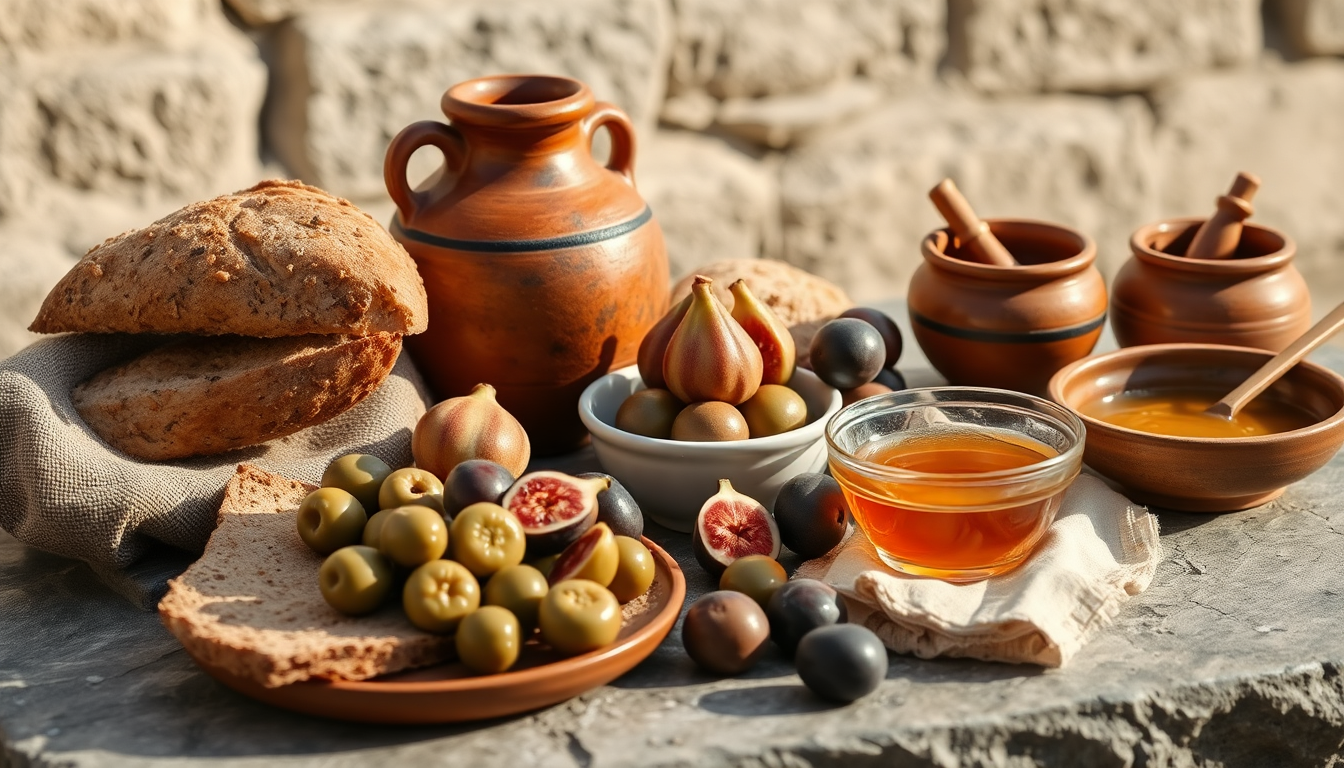
Ancient Greek Recipes
What Greeks really ate 2,500 years ago — and how you can cook it today
When we talk about ancient Greek food, most people picture a sparse plate of olives, bread, and wine. But the historical record tells a radically different story. From the 15-volume encyclopedia of food written by Athenaeus to Archestratus' gastronomic poetry, from Homer's detailed feast descriptions to fragments of the oldest cookbook in Western history, we know far more about what ancient Greeks ate than most people realize. This guide brings those scattered texts together — seven authentic ancient recipes adapted for your modern kitchen, the ingredients they used (and the ones that have gone extinct), and the cooking techniques that shaped one of history's most influential cuisines.
What Ancient Greeks Actually Ate
Popular culture paints ancient Greek food as bland and monotonous — endless bowls of olives and plain bread. The reality, preserved in centuries of texts, tells a completely different story.
The ancient Greek diet was built on what we now call the Mediterranean triad: grain, olive oil, and wine. But within those three pillars, there was extraordinary variety. Wheat, barley, millet, and spelt were ground into different flours. Olive oil came in grades — the first cold press for dressing, the second for cooking, the third for lamp fuel. And wine was mixed with water, honey, or spices depending on the occasion.
Protein came from fish (fresh and preserved), goat and sheep meat (beef was rare and associated with sacrifice), legumes (lentils, chickpeas, fava beans), and eggs. Cheese — especially fresh goat cheese — was a staple. Honey was the primary sweetener, and the Greeks had over 30 named varieties.
Primary Sources: Who Told Us About Ancient Greek Food
Unlike many ancient cuisines, Greek food is documented extensively. We know what they ate because several authors wrote about it in obsessive detail.
Athenaeus of Naucratis (circa 200 CE) wrote Deipnosophistae ("The Dinner-Table Philosophers"), a 15-volume encyclopedia of food, dining customs, and recipes. It's our single most important source. Athenaeus compiled accounts from over 800 earlier authors (most now lost), preserving recipes, ingredient lists, and dinner-table conversations.
Archestratus of Gela (4th century BCE) wrote Hedypatheia ("Life of Luxury"), a gastronomic poem traveling through the Mediterranean, documenting the best foods by region. Think of him as the world's first food critic.
Homer (circa 8th century BCE) described feasts in both the Iliad and Odyssey — including the famous scene where Odysseus's crew cooks the cattle of Helios, seasoning meat with wild thyme and savory.
Plutarch, Theophrastus, Ephippus, and Mnesitheus all contributed food writings, though much survives only as fragments quoted by later authors.
Seven Ancient Recipes, Modernized
These are not inventions. Each recipe below is adapted directly from descriptions in classical texts — adjusted for modern ingredients and kitchen equipment, but faithful to the original flavors and techniques.
1. Marathites (Fennel and Barley Porridge)
Source: Referenced in Athenaeus' Deipnosophistae
Original context: A humble daily food, common among laborers and farmers. Barley was the grain of the common people — wheat was for festivals and the wealthy.
Modern adaptation: Cook 1 cup pearl barley in 4 cups water for 35 minutes until soft. Drain. Toss with 2 tbsp olive oil, a handful of chopped fresh fennel fronds, salt, and a drizzle of honey. Serve warm. The original likely had more liquid — it was closer to a soup than a grain bowl.
Serves 4 · 20 minutes prep · 35 minutes cook
2. Teganites (Ancient Greek Pancakes)
Source: Athenaeus, citing a 5th-century BCE recipe
Original context: Street food. Athenaeus describes women selling teganites in the marketplace — thin pancakes cooked on a flat iron plate (teganon), drizzled with honey and sesame seeds.
Modern adaptation: Mix 1 cup flour, 1 egg, 1 cup milk (or water), pinch of salt, and 1 tbsp olive oil into a thin batter. Pour small amounts onto a hot oiled skillet. Cook until golden on each side. Drizzle with honey and sprinkle sesame seeds. The original had no sugar in the batter — all sweetness came from the honey topping.
Makes 8 pancakes · 10 minutes prep · 15 minutes cook
3. Meli Houmenon (Honey-Cheese Pastries)
Source: Athenaeus, quoting Mithaecus' 5th-century BCE cookbook (the oldest known cookbook in Western literature)
Original context: A festival food served during religious celebrations. Soft cheese wrapped in dough, fried, then drenched in honey.
Modern adaptation: Take fresh ricotta (closest to ancient fresh goat cheese), mix with a pinch of salt and dried oregano. Form into small balls. Wrap each in a thin strip of phyllo dough. Fry in olive oil until golden. Drizzle immediately with warm honey and crushed walnuts. Mithaecus' original specifies goat cheese and warns against using too much flour in the dough.
Makes 12 pastries · 15 minutes prep · 20 minutes cook
4. Kykeon (Ancient Greek Healing Drink)
Source: Homer's Iliad (Book XI) and the Eleusinian Mysteries
Original context: A ritual drink made from barley, water, and herbs. In the Iliad, it's served to wounded warriors. In the Eleusinian Mysteries (secret religious rites), kykeon contained ergot — a naturally occurring fungus — which historians believe produced altered states of consciousness.
Modern adaptation: Toast 2 tbsp barley flour in a dry pan until fragrant. Add to 2 cups water with 1 tsp dried mint and 1 tsp fresh thyme. Simmer 10 minutes. Strain. Add honey to taste. This is a genuinely refreshing drink — nutty, herbaceous, slightly sweet. The ergot has been intentionally omitted for obvious reasons.
Serves 2 · 5 minutes prep · 10 minutes cook
5. Opsos (Rich Meat Stew)
Source: Archestratus' Hedypatheia and Athenaeus
Original context: A complex stew featuring multiple meats, wine, and garum (fermented fish sauce — the ketchup of the ancient world). Archestratus specifies that the best opsos uses young goat meat and insists on wine from Chios.
Modern adaptation: Brown 1 lb cubed lamb shoulder in olive oil. Add 1 diced onion, 3 crushed garlic cloves, 1 tsp ground cumin, 1 tsp dried coriander. Pour in 1 cup dry red wine and 1 cup water. Add a pinch of dried rue (optional but authentic). Simmer 1.5 hours until falling apart. The garum has been replaced with 1 tbsp fish sauce — functionally identical in cooking. Serve over barley.
Serves 4 · 15 minutes prep · 1.5 hours cook
6. Thyos Kottabos (Roasted Quail with Spices)
Source: Athenaeus, describing symposium cuisine
Original context: Small birds were a luxury at symposia (drinking parties). Athenaeus describes quail roasted with silphium (now extinct), cumin, and coriander seeds, then served with a garum-based sauce.
Modern adaptation: Season 4 whole quail with olive oil, 1 tsp cumin, 1 tsp coriander seeds (crushed), salt, and a pinch of asafoetida (closest living relative to the extinct silphium). Roast at 400°F for 25 minutes. Serve with a sauce of 2 tbsp honey mixed with 1 tbsp red wine vinegar and 1 tsp fish sauce. Baste the quail halfway through with the sauce.
Serves 4 · 10 minutes prep · 25 minutes cook
7. Epityrum (Ancient Olive Relish)
Source: Cato the Elder's De Agri Cultura (Roman, but based on Greek originals)
Original context: A table condiment made from crushed olives — the ancestor of modern tapenade and olive spread. Theophrastus mentions similar preparations in Greek sources.
Modern adaptation: Pit 2 cups mixed olives (Kalamata, green, and black). Crush roughly with a mortar and pestle — don't use a food processor; the original texture was chunky, not smooth. Mix with 2 tbsp olive oil, 1 tbsp red wine vinegar, 1 tsp dried oregano, 1 minced garlic clove, and a pinch of cumin. Let sit 30 minutes before serving with bread.
Serves 6 · 15 minutes prep · 0 minutes cook
Ingredients: Then vs. Now
Several ingredients the Greeks depended on no longer exist. Others have been transformed beyond recognition. Understanding these differences is key to cooking ancient recipes successfully.
Silphium: Prized herb/spice from Cyrene (Libya). Worth its weight in silver. Used on virtually everything. Modern substitute: Asafoetida (hing) — closest surviving flavor profile. Also: fennel pollen or lovage.
Garum: Fermented fish sauce. Not optional — the primary seasoning in most dishes. Ranged from cheap (sardines) to luxury (tuna). Modern substitute: Fish sauce (Thai/Vietnamese). Colatura di alici (Italian, directly descended from garum).
Lory/Elaterion: Wild celery and bitter herbs used as flavorings and medicines. Modern substitute: Celery leaves + a small amount of arugula (for bitterness).
Pearl Barley: The everyday grain. More common than wheat for most people. Made into porridge, bread, and thickened soups. Modern substitute: Unchanged. Still available and identical.
Pure Wine (Akratos): Undiluted wine was considered barbaric. Greeks always mixed wine with water (2:1 or 3:1 ratio). Modern substitute: Light red wines (Xinomavro, Agiorgitiko) diluted with water — try it, it works.
Honey (Meli): The only sweetener. Thyme honey was most prized. Used in savory dishes as much as sweet ones. Modern substitute: Greek thyme honey (still produced). No substitution needed.
Ancient Cooking Techniques
The Greeks had no ovens at home (communal ovens existed but most cooking was done over open flames or charcoal). Their equipment shaped their cuisine.
Teganon (Flat Iron Pan): A flat metal plate placed over coals. Used for pancakes, flatbreads, and searing meat. The ancestor of the comal, crepe pan, and griddle.
Chous (Clay Pot): Slow-cooked stews and braises. Clay pots were buried in hot coals — the original slow cooker. A few hours at low, steady heat.
Eschara (Open Grill): Charcoal grill. Used primarily for meat and fish. The word gives us "escargot" and related grilling terms. Direct heat, quick cooking.
Pithos (Large Storage Jar): Not a cooking vessel, but essential. Used to store olive oil, wine, grain, and preserved fish. Underground pithoi kept contents cool — ancient refrigeration.
How Greek Food Evolved
The food we call "Greek" today is the result of 2,500 years of continuous evolution — not a frozen-in-time tradition.
The Byzantine period (330–1453 CE) added sugar, citrus, and Eastern spices like cinnamon and nutmeg. The Ottoman occupation (1453–1821) introduced phyllo pastry, stuffed vegetables (dolmadakia), coffee, and yogurt-based dishes. The 20th century brought tomatoes (from the Americas), potatoes, and peppers — none of which existed in ancient Greece.
This means that when you eat modern moussaka, spanakopita, or pastitsio, you're eating dishes that would be completely unrecognizable to an ancient Athenian. Tomatoes in moussaka? Potatoes in pastitsio? These ingredients arrived 2,000 years too late.
The ancient flavors that still survive in modern Greek cooking: olive oil, honey, oregano, thyme, lemon, garlic, feta-like cheeses, yogurt, and lamb. These are the threads connecting 2,500 years of Greek food tradition.
Myths vs. Reality
Myth: "Ancient Greeks were all vegetarians" — Reality: While many Greeks ate meat rarely (it was expensive), they were not vegetarians. Animal sacrifice was central to religion — and the meat was eaten at communal feasts. Pork, goat, lamb, and fish were all consumed regularly by those who could afford them.
Myth: "Greek food has always been the same" — Reality: Ancient Greek food bears little resemblance to modern Greek cuisine. No tomatoes, no potatoes, no phyllo, no coffee, no yogurt with honey. Modern Greek food is a product of Ottoman, Byzantine, and Mediterranean influences accumulated over millennia.
Myth: "They only ate simple peasant food" — Reality: Athenaeus describes elaborate banquets with dozens of courses, exotic sauces, stuffed animals, and culinary artistry that rivals any modern restaurant. Greek gastronomy was sophisticated — and documented extensively.
Cooking Ancient Greek Food Today
You don't need special equipment or impossible-to-find ingredients. Most ancient Greek cooking is surprisingly accessible in a modern kitchen.
Start with the basics: good olive oil, pearl barley, Greek honey, and fresh herbs (oregano, thyme, fennel). These four ingredients are unchanged from antiquity and form the backbone of almost every ancient recipe.
The biggest adjustment is flavor balance. Ancient Greek food was more herbaceous, more honeyed, and more reliant on fermented fish sauce than modern Greek food. If you've never cooked with fish sauce, start small — 1 teaspoon in a stew transforms the umami depth in exactly the way the Greeks intended.
The Thread That Connects 2,500 Years
What becomes clear after spending time with these ancient texts is that Greek food was never the simple peasant cuisine we've been led to believe. It was a cuisine of extraordinary range — from the barley porridge of field workers to the elaborate multi-course banquets of the symposia. It was a cuisine that valued fermentation (garum, wine, vinegar), preservation (salted fish, cured olives, honey-soaked fruits), and the transformative power of fire on raw ingredients.
The most striking thing about cooking these ancient recipes today is how familiar they feel. A honey-drizzled cheese pastry doesn't taste foreign. A herb-scented barley porridge doesn't feel exotic. These flavors resonate because they're the deep roots of the Mediterranean cooking that billions of people eat every day. When you make teganites with honey and sesame, you're not making a novelty — you're making one of the oldest continuously prepared dishes in human history.
If this exploration of ancient Greek food sparked your curiosity, the natural next step is to explore how these ancient foundations evolved into the traditional Greek recipes we know today — dishes like moussaka, spanakopita, and pastitsio that carry the same olive oil, honey, and herb DNA — transformed by centuries of cultural exchange into something entirely new, yet unmistakably Greek.
For a deeper dive into the traditional Greek recipes that evolved from these ancient roots, explore our complete collection of authentic Greek dishes — from chicken souvlaki to lemon chicken and everything in between.
Frequently Asked Questions
What did ancient Greeks eat for breakfast? — Ancient Greeks ate a simple breakfast called akrismos — barley bread dipped in wine, often accompanied by olives, figs, or a piece of cheese. It was quick, practical, and required no cooking. The wealthy might add honey or eggs, but for most people, breakfast was about fuel, not ceremony.
Did ancient Greeks have olive oil? — Yes — olive oil was foundational. The ancient Greek diet was built on the "Mediterranean triad" of grain, olive oil, and wine. Olive oil came in different grades: the first cold press for dressing food, the second for cooking, and the third for fueling lamps. Greece's climate was perfect for olive cultivation, and oil was traded across the entire Mediterranean.
What is garum and did ancient Greeks use it? — Garum was a fermented fish sauce that served as the primary seasoning in most ancient Greek dishes — essentially the ketchup of the ancient world. It ranged from cheap (made from sardines) to luxury (made from tuna). Modern fish sauce (Thai or Vietnamese) or Italian colatura di alici is functionally identical. It adds deep umami without tasting "fishy."
Did ancient Greeks eat meat? — Yes. While meat was expensive and not an everyday food for most people, Greeks regularly ate goat, sheep, pork, and fish. Beef was rare because cattle were used for plowing and religious sacrifice. Animal sacrifice at temples was a major source of communal meat feasts — the sacrificed animal was roasted and shared among the community.
How is ancient Greek food different from modern Greek food? — Ancient Greek food had no tomatoes, potatoes, peppers, corn, or phyllo pastry — these ingredients arrived centuries later through Ottoman, Byzantine, and Columbian Exchange influences. Ancient Greek cuisine was simpler in structure but more reliant on fermented fish sauce (garum), silphium (now extinct), and honey as a universal sweetener. The ancient flavors that survive today: olive oil, oregano, thyme, lemon, garlic, and lamb.
What are some authentic ancient Greek recipes I can try at home? — Easy recipes to start with include teganites (honey pancakes from a 5th-century BCE recipe), epityrum (ancient olive relish), kykeon (a barley and herb healing drink from Homer's Iliad), and meli houmenon (honey-cheese pastries from the oldest known cookbook). All use ingredients available at any grocery store and require no special equipment.